
Candidate sentiment survey: Part one – salaries, workloads and trade-offs
Paul McArdle | Talent & Recruitment Columnist | The Currency

The Panel is a recruitment consultancy that places talent at the C-suite level across all business sectors. Twice a year, we conduct a Candidate Sentiment Survey in association with The Currency to gauge candidates’ attitudes toward specific topics.
- 1,632 candidates completed the survey.
- The candidates surveyed were from junior management to the C-suite level in the IT, finance, accounting, legal, HR, banking, and ESG professions.
- The candidates were presented with a multiple-choice answer for every question.
- Where the same question was asked in our Autumn 2023 survey, we compare it to Autumn 2024.
- The survey had a “free text” box at the end, and close to 10 per cent of the candidates chose to give us their observations on certain topics. Their observations are under the relevant questions in italics.
In part one of this two-part survey, we examine the trade-offs on salaries that workers are willing to make.
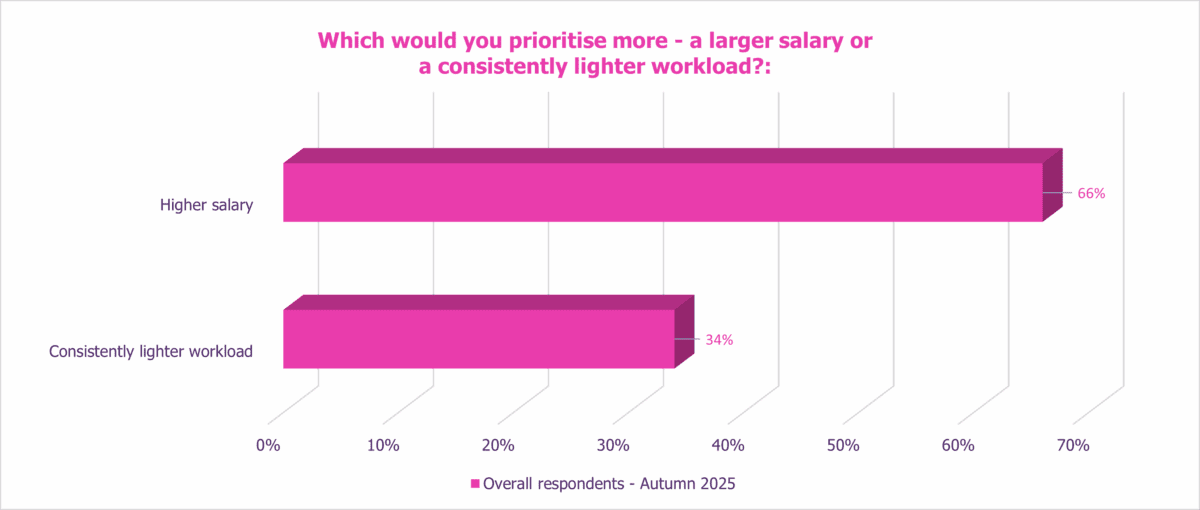
With work-life balance increasingly on candidates’ minds when assessing career opportunities, we wanted to gauge which was more important: a higher salary or a lighter workload. Twice as many candidates value a higher salary over working less. That one in three respondents would sacrifice salary for a better work-life balance is significant and worth noting by employers.
What the respondents said:
“People always assume I am to keep earning what I am earning and working at the same level of responsibility. I don’t. I want to work because I enjoy it; however, I would like to have more time for myself and my family than I currently do. I would be willing to work fewer hours for a lower salary.“
“As I grow older, I find myself less driven by career prospects and more motivated by family and well-being. I’d rather be a happy admin than a sick CEO.“
“Assuming a linear relationship between less workload and less salary is spurious. It’s the politically adept who rise through the ranks in organisations; oftentimes, politics is detached from production.“
“I moved jobs and ended up with a lower salary, but it’s turning out to be more difficult to manage than expected.“
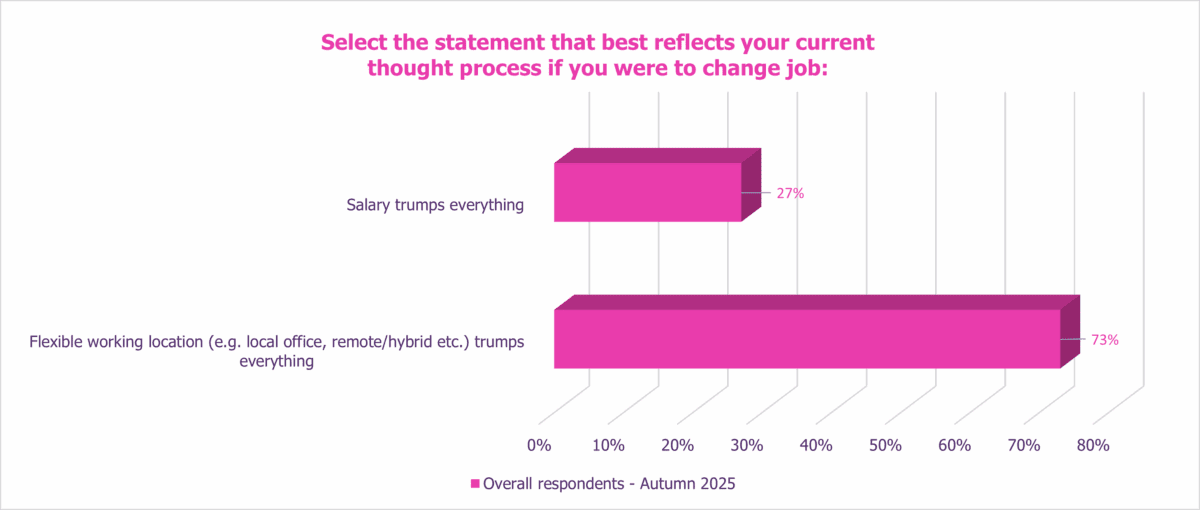
This is not a question we would have asked our candidates pre-Covid. The pandemic has changed everything in how and where candidates work, with a greater emphasis placed on the work itself than on the salary on offer.
In The Panel, we spend more time negotiating working conditions than salary expectations. The fact that three times as many candidates value how they work over their salary is an interesting and significant dynamic in the recruitment process.
What the respondents said:
“I actively avoid any job listing that requires five days in the office. With having to balance kids/school, I require a job that is close to home and has some allowance for working from home so I can accommodate events such as elections where the schools are all off.“
“Focus on salary needs a little more nuance as items such as culture, work environment and work/life balance are highly important, as is job security.“
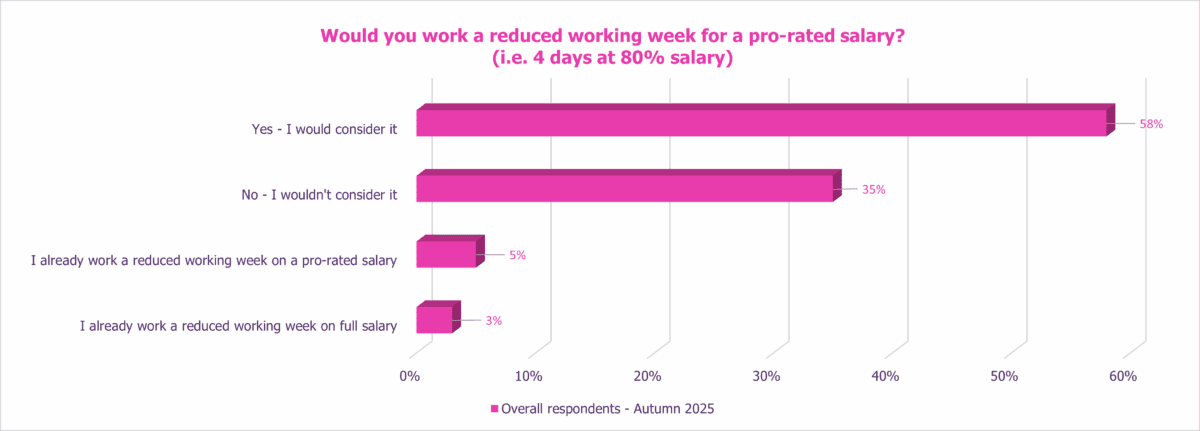
Annual leave is becoming more important when we negotiate salary packages on behalf of candidates. While half of the respondents would not trade salary for annual leave or vice versa, those who would consider the trade want more annual leave days than salary.
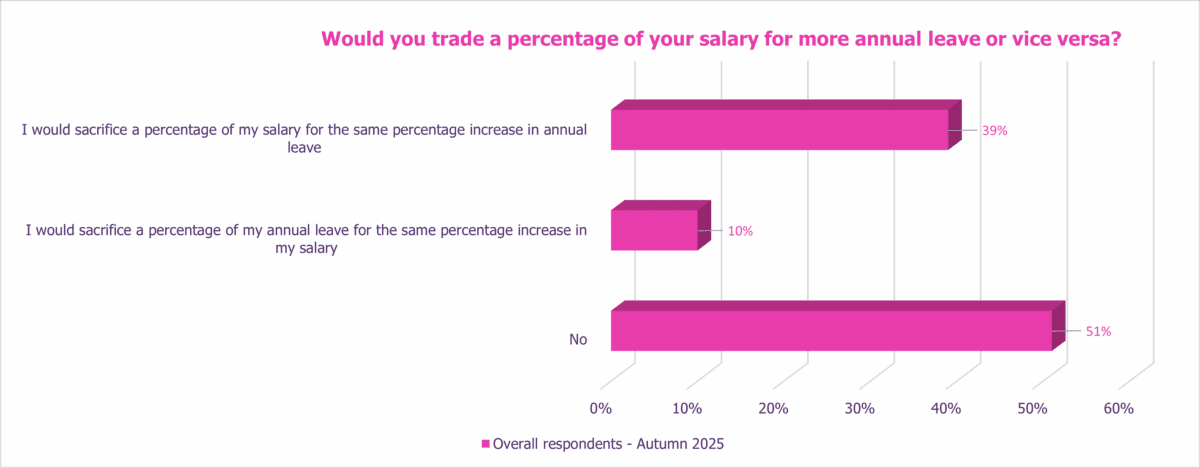
With more chatter about four-day working weeks, the fact that six out of every ten respondents would consider a four-day workweek at a prorated salary is significant. One in 20 of our candidates is already working this way, with 3 per cent working a four-day week on a full salary.
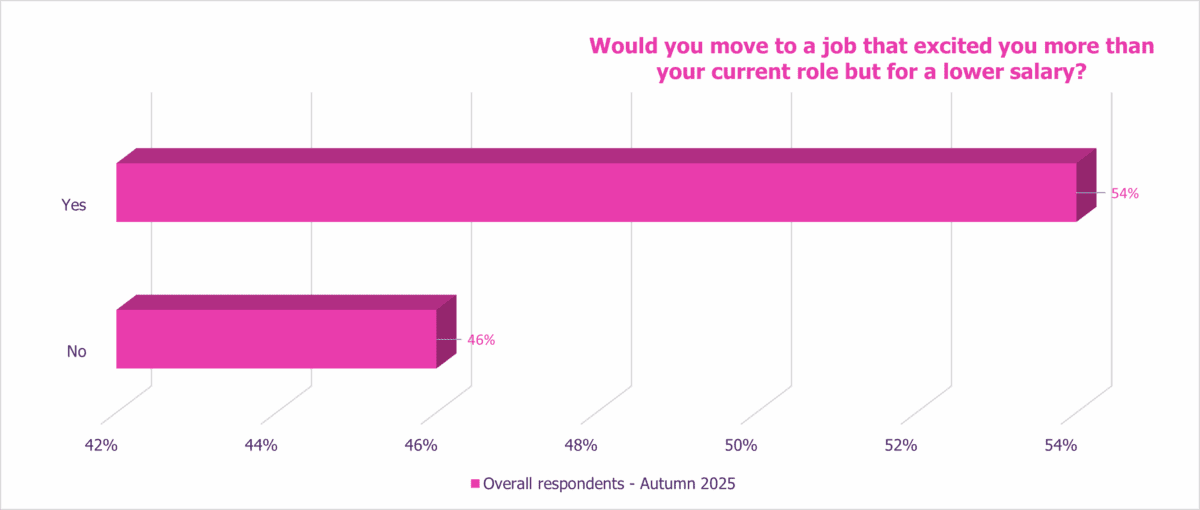
We often get candidates prioritising the type of role they do over their market rate salary. In our experience, respondents who chose this option are either experienced candidates who are financially secure and can afford a reduced salary or candidates who have a passion for working in a specific sector, such as the charity sector.
Our older candidates have something to say:
One aspect of the survey we have is a “free text” section, where candidates can make their own observations. Several respondents spoke about ageism in the job market. For balance, we are including a sample of their contributions.
“The survey doesn’t include anything that people in their later years might want or be considering. This is a highly valuable cohort whose needs often get overlooked by employers and recruiters.“
“The remedy for ageing in the workforce requires us to continue to add world-class education credentials to our CVs and become an SME. I now work for both a large fintech company and a top research university. Keep going, don’t let anyone push you to retirement.“
“Probably need to focus on older people – they may be looking for a shorter working week or more fixed-term, related work with the ability to take extra time off in between.“
“Younger employees are more suitable and keener for office work, where older employees, closer to retirement, should now have earned the right to choose.. A 4-day week would be a great option, even with the same hours, as most people working in corporates probably work the same hours in 4 days anyway.“
“I’d like more questions surrounding the impact of age on obtaining employment.“
I am 74 years old, and hence changing jobs is not as easy as it was earlier in my career.
Survey aimed at younger audiences.
Have been testing the market and encountering perceived ageism – “experience bigger than the role”,” prefer someone mid-career”, etc., a major inhibitor!
Further Reading
Part two — the shifting balance of power between employees and employers