
Candidate sentiment survey: Part two — the shifting balance of power between employees and employers
Paul McArdle | Talent & Recruitment Columnist | The Currency
The Panel is a recruitment consultancy that places talent at the C-suite level across all business sectors. Twice a year, we conduct a Candidate Sentiment Survey in association with The Currency to gauge candidates’ attitudes toward specific topics.
- 1,632 candidates completed the survey.
- The candidates surveyed were from junior management to the C-suite level in the IT, finance, accounting, legal, HR, banking, and ESG professions.
- The candidates were presented with a multiple-choice answer for every question.
- Where the same question was asked in our Autumn 2023 survey, we compare it to Autumn 2024.
- The survey had a “free text” box at the end, and close to 10 per cent of the candidates chose to give us their observations on certain topics. Their observations are under the relevant questions in italics.
In part two of this two-part survey, we examine hybrid working, employee expectations and the shifting balance of power between employees and employers
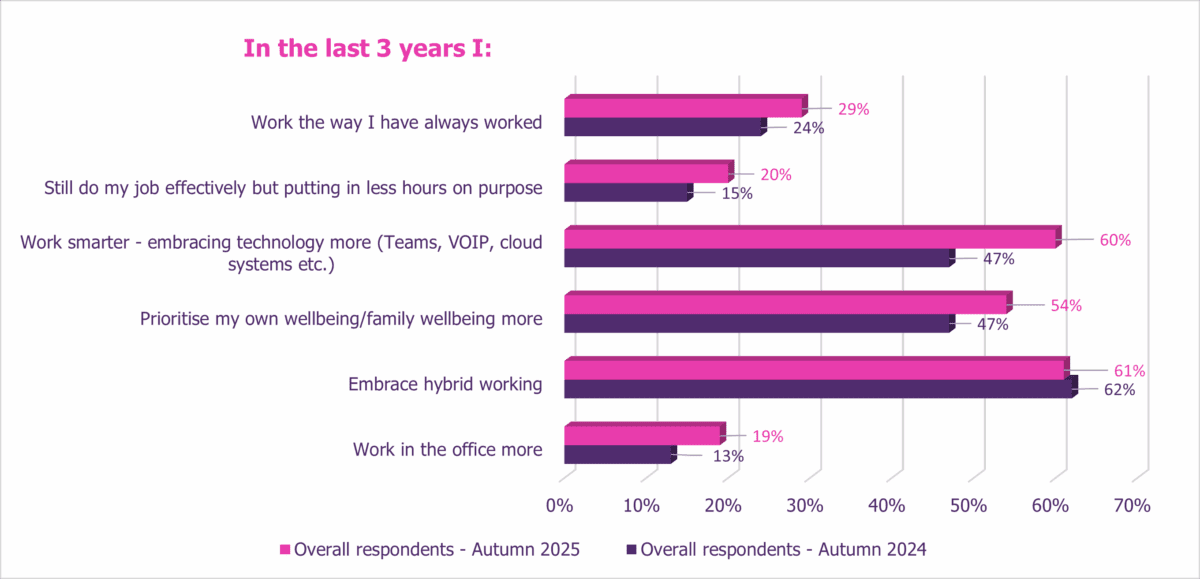
There were some notable shifts over the last year:
- A third more (15 per cent to 20 per cent) of our respondents feel they are still doing their jobs but working fewer hours; this is a significant increase.
- This ties in with the increase in working smarter, up close to a third also (47 per cent to 60 per cent), possibly AI-related.
- There is an increase of 50 per cent of candidates working in the office more (13 per cent to 19 per cent), a trend that backs up what we in The Panel are seeing, as more clients mandate a return to the office.
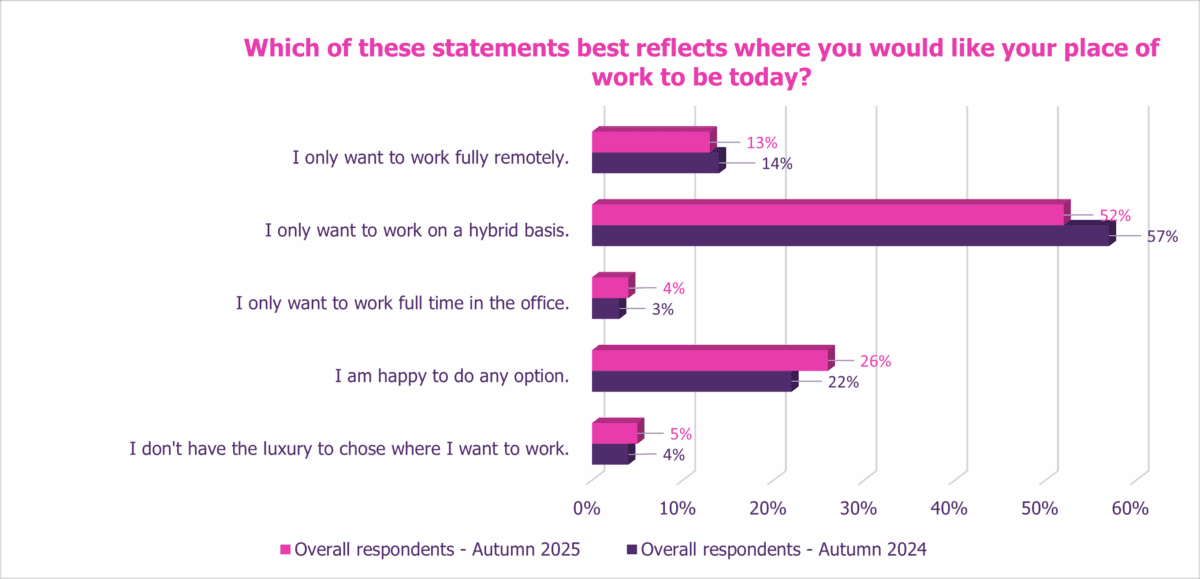
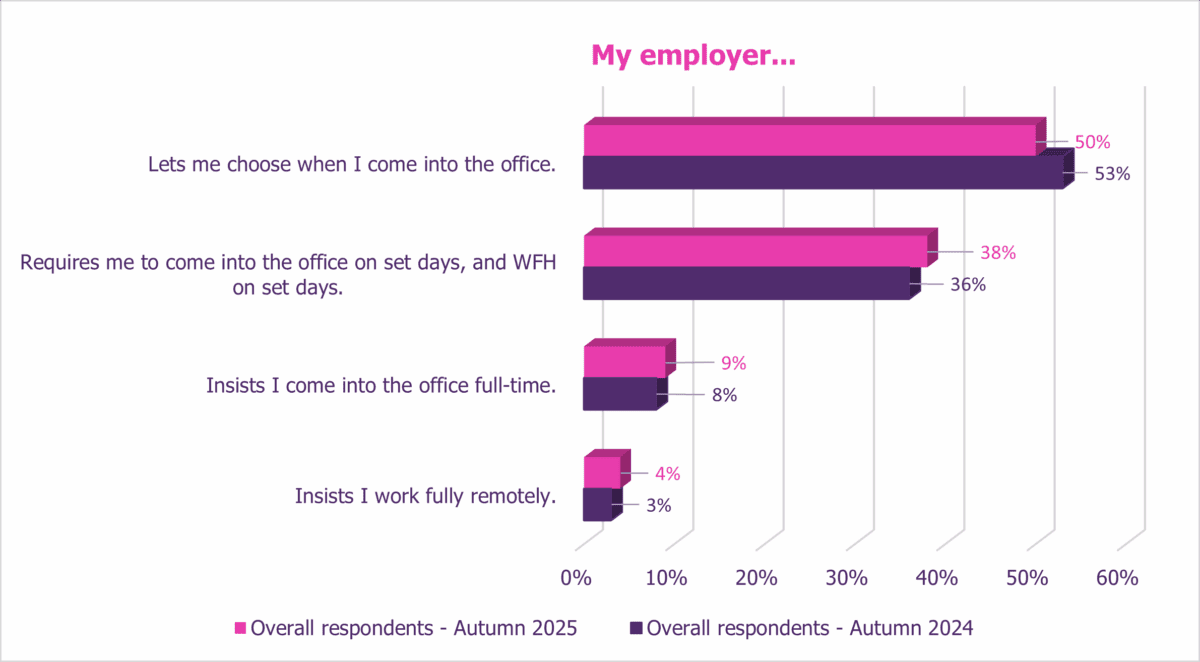
Again, there are no significant variances from our last Autumn survey. The incremental changes are more focused on attending the office than WFH; we were expecting the RTO figures to be higher.
What the respondents said:
“Employers need to consider employees with young children who were born during the Covid-19 pandemic and are accustomed to having parents around. The commute to the office adds stress and less work being done.“
“Location is key, too. Hybrid is less important if close to the office, with a consistent commute of less than 40 minutes.“
“Things go in cycles. Come the next recession or even downturn, and jobs become scarcer, the current employees’ market will shift back to being more of an employers’ market, where they will dictate working arrangements more than today, in my opinion, and more people will be in the office more frequently.“
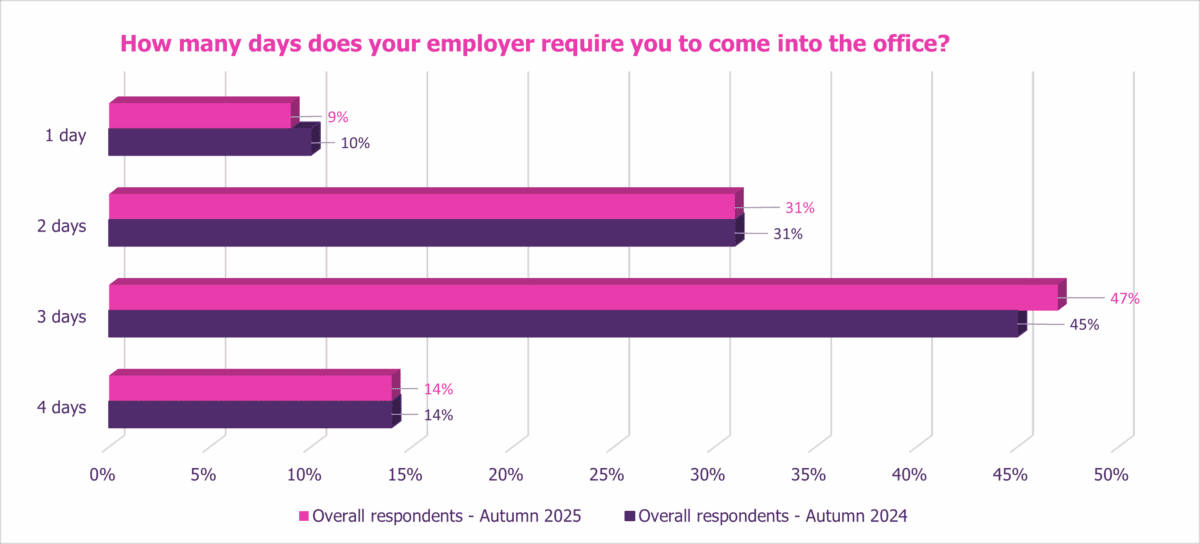
Three days in the office and two days WFH is now the most popular hybrid working option. In previous years, the two days in the office and three days WFH were as popular, but there is a clear movement towards being in the office more.
What the respondents said:
“People who are required to work in the office often engage in “coffee badging,” where they are seen and then leave home for lunch. Insisting on set office days without any incentive is failing to attract and retain employees. “
“I hope my employer doesn’t push for more time in the office. 3 days is already a struggle for me with a young family.“
“I am happy with my work arrangements at the moment. The flexibility and work-life balance are super.“
“Two days in the office is a perfect balance to meet others, but it’s easier to get work done at home. 3 is too much.”
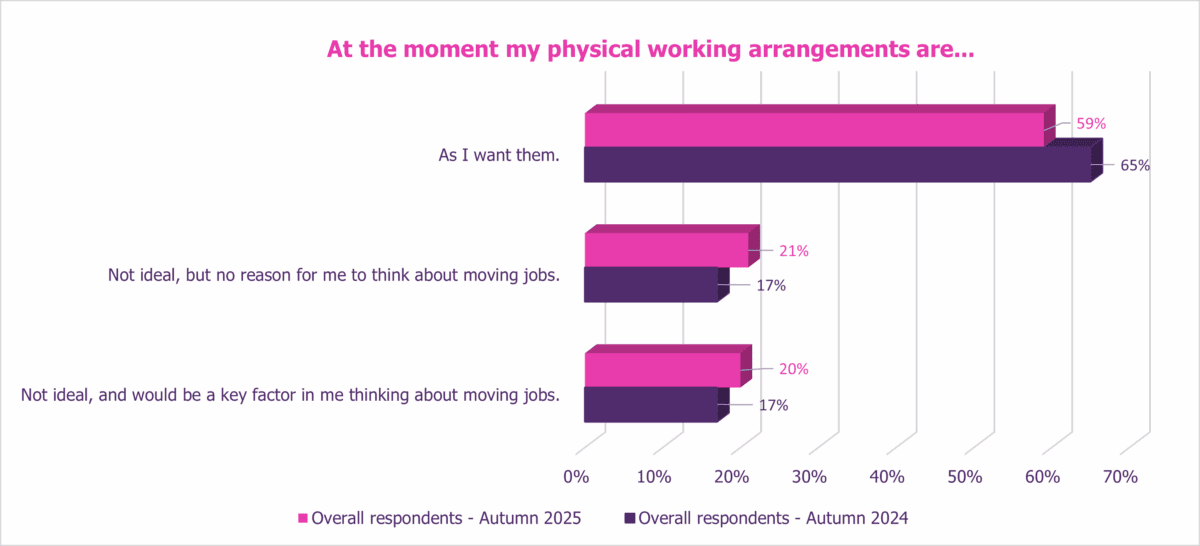
With the return to the office mandates of employers, we are seeing a shift in candidates’ sentiments.
- A close to 10 per cent fall in their preferred working arrangements (65 per cent to 59 per cent).
- While other candidates do not find their working arrangements ideal, one-in-five see this as a key factor in considering moving jobs.
What the respondents said:
“I feel there is too much of a push to return to office more, which I think is too much. It’s definitely possible to WFH the majority of the time and understand collaboration is important and needed for new joiners but WFH should be encouraged for traditional office-based roles.“
“The job market in a post-Covid world no longer reflects the needs of society. Particularly in Ireland, we’ve seen a significant shift of companies enforcing return to work while simultaneously a government refusing to fund childcare options, placing the impetus on working-class families to either find more flexible jobs or take a step back career-wise. Combine this with the rise of ghost jobs, my overall view is that until companies prioritise the well-being of working parents, we will see increased underemployment of women and a detrimental hit to the economy overall.“
“Flexibility of hybrid and working hours is the most important thing for me. However, I don’t believe you should have to sacrifice salary for that, why should flexibility devalue a role? Also, a company that demands full on-site presence in the current workplace not only shows themselves up in terms of lack of flexibility of working location but for me is also a red flag for a questionable culture and leadership team who doesn’t trust and value its staff – one to avoid! If a role is advertised as fully on-site, I scroll on by!“
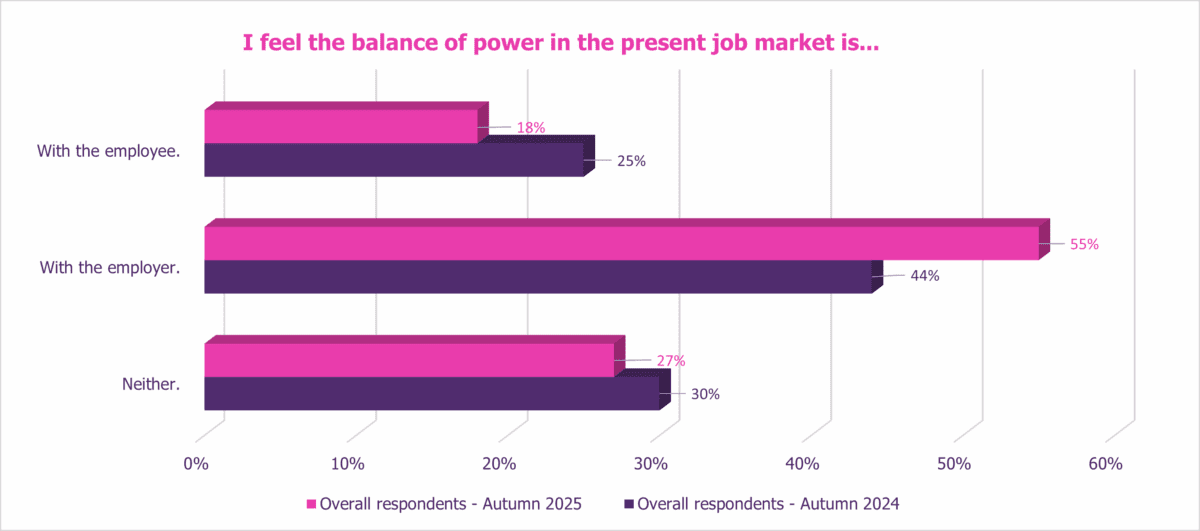
This is the finding of the survey. We have seen a shift in candidate sentiment over the last few surveys, reflecting a more balanced power dynamic in favour of the employer. These results are more pronounced; it is definitely an employer market.
A 25 per cent jump (from 44 per cent to 55 per cent) in the number of candidates who believe it is an employer-driven market, with less than one in five candidates believing it to be a candidate-driven market, is emphatic. In The Panel, we are seeing candidates having to be more flexible, while clients are becoming more prescriptive with their requirements.
What the respondents said:
“Power is currently with the employer but is likely to shift if the employment market changes and employees are viewed more as a valuable resource rather than a necessary component for the effective operation of the business.“
“Companies, in general, still pay lip service to the importance of employee welfare. Most are still treating them as costs, not business partners.“
“I find employers are expecting more overtime hours, with an inappropriate work/life balance and without offering any time off in lieu.“
“Unfortunate shift back to the office, less flexibility.“
“Mandated back to the office has a very negative impact on overall culture and team spirit. It’s creating a toxic and resentful atmosphere. Increased travel/ childminding/ pet minding costs are not absorbed by the company, which further leads to resentment.“
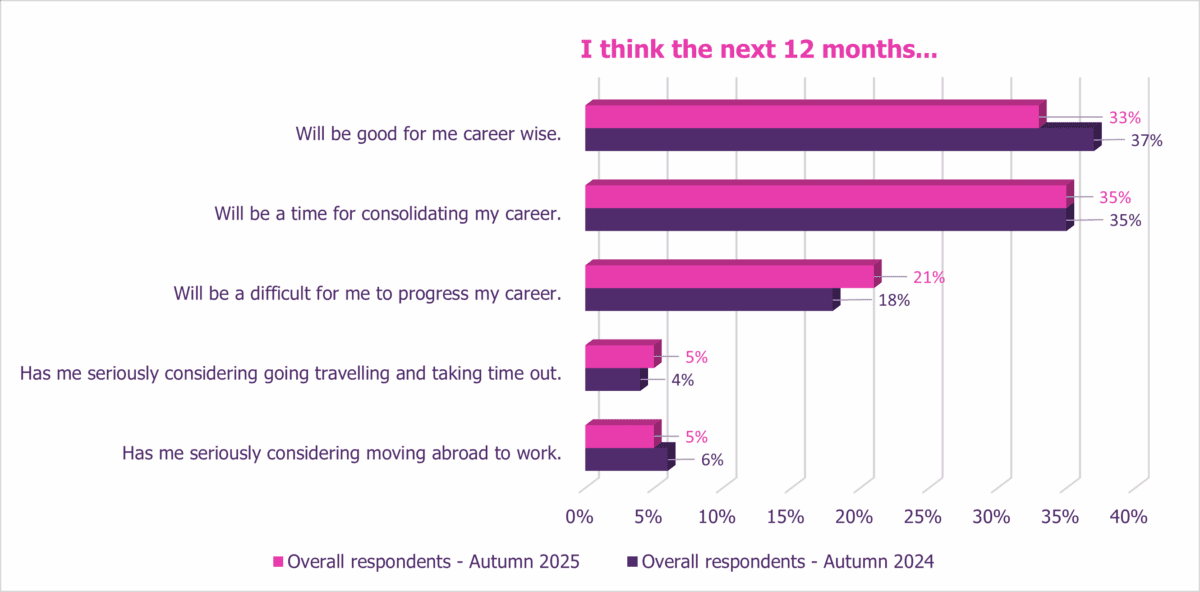
The underlying trend here is that fewer candidates are as confident about their career prospects over the next 12 months. One in ten respondents is considering taking time out or emigrating. Over half of the respondents believe they will find it challenging to advance in their careers, with many seeking to consolidate their current positions.
What the respondents said:
“Budget 2026 has been harmful for employees.“
“The labour market is currently imbalanced.“
“After many years of work and a good amount of money in my bank, I don’t have the opportunity to buy a house. In other countries, such as Italy, Spain, France, and Germany, the money I saved is enough to buy a home. I’m thinking of moving to an area where I can buy a house.“
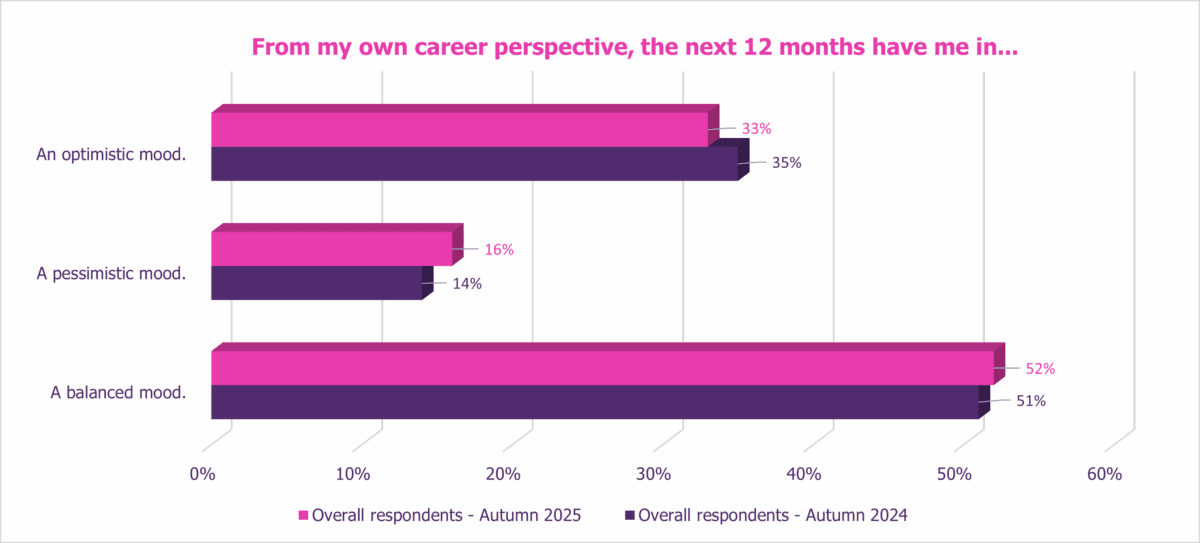
Consistent with other surveys, candidates are slightly more pessimistic than they were last year, but there is no significant variation.
What the respondents said:
“I think the next 12 months will be a nervous time.“
“2026 will be a challenging year, as AI will lead to rationalisation, where jobs are lost, and others will be asked to take up the slack. Employers will use AI as the reason.“
Further reading
